Three crucial holes that can make or break your round
Four-time DP World Tour winner and 2012 Dubai Desert Classic champion Rafa Cabrera Bello shares his strategic insights on three of the Majlis’ most pivotal holes, while Emirates Golf Club Senior Teaching Professional Tom Ogilvie explains how amateurs can tackle those same challenges.
HOLE 8 | PAR 4 | 459 YARDS | STROKE INDEX 3
Rafa Cabrera Bello:
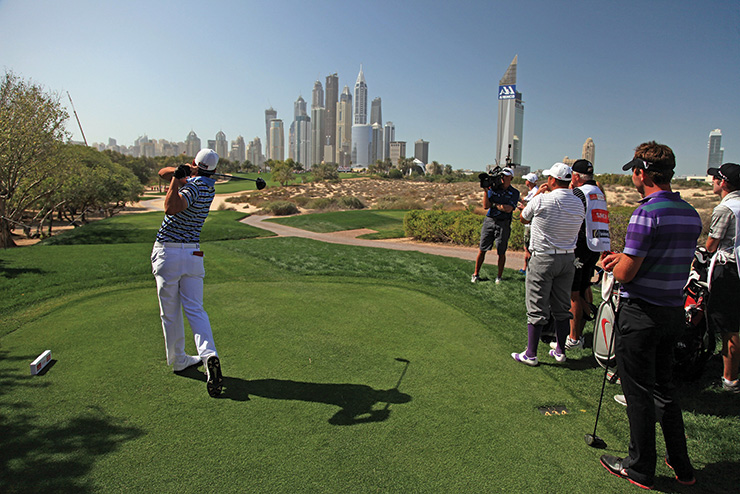
Beautiful tee shot with the skyscrapers in the background. Very exposed to the wind too. Also, you would like to cut over as much of the desert as you can, but very wind dependent on how much you can chew on. There’s a palm tree that normally is a very good reference point for most players of how far right you want to finish the drive and still be in the fairway. Favouring the left side is clearly safer, but also not a freebie since many years there thick rough that makes the second shot pretty hard.
I feel the second shot always plays a little longer than the math. Definitely not a green you want to miss long. Left and right misses might be fine unless you’ve really short sided yourself. Green has a big slope from back to front that makes chipping from pin high tricky. Middle of the green in days the hole is playing long because of the wind is normally a good result. With no wind and a good drive you can be a bit more aggressive but I feel that with a par you’re gaining on the field.
Tom Ogilvie:
This is my favourite tee shot in the UAE. A slight dogleg to the right usually plays into a prevailing wind, so try to hug the left side of the fairway. A fully committed drive is required, which will leave you a mid to long iron into the green.

My top tip here is to double-check where the flag is on the green. From down below in the fairway, you can’t see the bottom of the flag. If it sits at the back, do not go long of the green. Leaving yourself below the hole will give you a much easier chip, or hopefully a putt, up the green for birdie. Enjoy it, it’s a cracker.
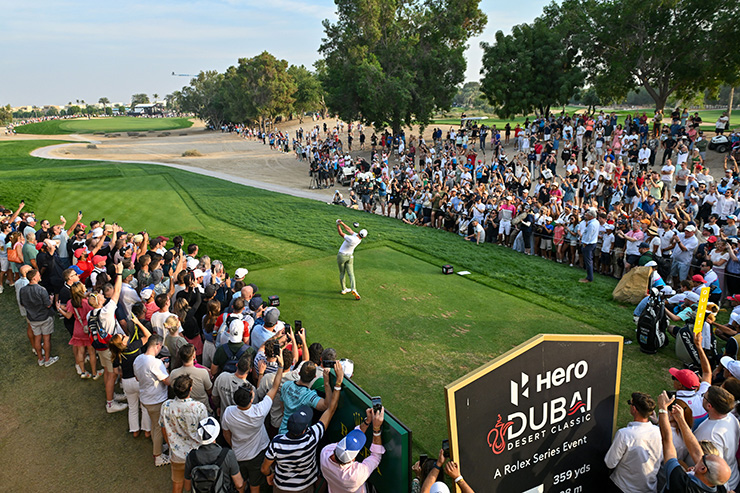
HOLE 17 | PAR 4 | 359 YARDS | STROKE INDEX 16
Rafa Cabrera Bello:
Drivable par four always gives a lot of options. Most of the really long hitters will give it a try almost daily, but someone like myself has to take other things into consideration before taking it on. Firstly, the wind – into the wind is a no go for me, I’ll probably hit a 3 iron or 5 wood straight to the middle of the fairway. It looks like a very wide fairway off the tee, and it is, but you could end up in the right side of the fairway and be blocked by some very well placed palm trees, so when I’m playing safe off the tee, it takes good commitment to look for the middle, even the left side so that the shot to the green is unobstructed.
If we have a downwind breeze, then the driver comes into play. I personally need my absolute best drive to reach the green, so with thick rough around the green I will check for the pin position. Any pins in the right-hand side of the green, especially the back right one, and I will also play safe from the tee. For me the ideal pin to go for it will be the back left pin, because if I don’t reach the green, I will have still have a lot of room and green to use for the chip shot. Very exciting hole that can allow from eagle to bogey or worse in a very narrow margin.
Tom Ogilvie:
The 17th is a real birdie chance. If you’re feeling confident with the driver, take it on. You’ll need to aim slightly right and carry it over the trees. It’s a short par 4 which, for the longer hitter, can get you close to the green or leave a short pitch into a narrow target.
For the more conservative golfer, a 3 wood or long iron from the tee will leave a short to mid iron in. A generously wide fairway awaits, but the green is significantly longer than it is wide, so an accurate approach is required.
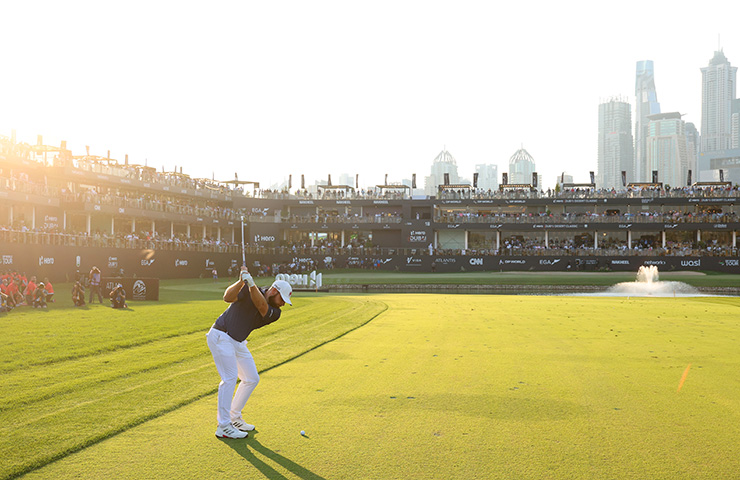
HOLE 18 | PAR 5 | 546 YARDS | STROKE INDEX 12
Rafa Cabrera Bello:
Tough tee shot to hit the fairway. Very narrow ‘actual’ fairway if you want to take it on in two. Ideally, a high draw is what most guys will try to hit, but if you just draw it a tiny bit too much because of the angle of the dogleg it will make it very difficult to carry. On the other hand, if you don’t draw the ball enough you could run through the fairway into the rough and/or leave yourself too long of a second shot to go for the green. If you’re laying up, it could be crucial to hit the fairway and leave yourself a comfortable number to the pin.
For the pins on the left, it’s much easier, the green is way deeper and there is a slope that will help you stop the ball if you’re coming out of the rough and even feed it close to the hole depending on the pin placement. For the typical Sunday pin that is tuck on the right, the green will be pretty short for your landing area. Water short will be an immediate penalty, and the bunker long will most likely force you to play safe out, not even going at the pin, costing you a very disappointing and likely bogey to finish.
Assuming you’ve hit a great drive and you’re in range to go for it it’s a very inviting shot to actually go for it. Again, pin placement will make it easier or tougher specially for the eagle chance. You have room left, and a grandstand long left that will allow you to hit an extra club if you can’t afford to go in the lake. The up and downs from the left are very makeable, but get tougher the further right the pin is. And if you’ve managed to hit the green you’ll be happy to have the eagle chance.
Tom Ogilvie:
This is fantastic par 5 finishing hole that shapes from right to left and really tests your bravery. The more you cut the corner, the shorter the second shot becomes, which may give you the chance to take on the green over the water. Colin Montgomerie famously hit driver off the deck here to claim the 1996 European Tour Shot of the Year, so keep an eye out for his plaque.
For those who lay up, a straightforward mid to long iron will leave a short approach over the water.
If you decide to take on the green, the conservative line is up the left side, which leaves a pitch across the green. Sloping from back to front, a slippery putt awaits if you find yourself past the flag, putting back towards the water.
Follow Golf Digest Middle East on social media
Main Image: Supplied