A few weeks ago a reader of my Golf IQ newsletter, asked an interesting question. He was worried, in short, that one of his arms was so weak that it was slowing down his golf swing.
As a right-handed golfer who does everything else in life with my right hand, and almost nothing with his left, it got me wondering. So, I called up Dr. Sasho MacKenzie, one of golf’s foremost biomechanists and the founder of the speed-boosting Stack Training Aid, and peppered him with some questions.
Is one of this reader’s arms costing him distance?
Is one of my arms costing me distance?
Is this something golfers should care about in the first place?
“Intuitively, a lot of golfers have the sense that this is something that matters,” Sasho says. “So unless someone answers those questions, it’s always going to be in the back of their mind.”
At that point, Sasho started sharing a bunch of interesting graphs, and explaining what the rest of us can learn from them.
First things first, if you’re wondering what the norm is among your peers: 93 percent of golfers who play golf right-handed also throw right-handed. Interestingly, though, this is slightly different for golfers who play left-handed: Just 46 per cent of those golfers also throw with their left hand.
Here are some interesting dexterity facts from our ~36,000 Stackers @TheStackSystem
8% throw with their left hand
93% play golf right-handed
95% of those right-handed golfers throw with their right hand
Left-handed golfers are marginally more likely to throw with their… pic.twitter.com/iu7oZqV0ez
— Sasho MacKenzie (@SashoMacKenzie) March 4, 2024
“A right-handed baseball player may catch with their left hand. A right-foot dominant basketball player may jump off their left leg. The golf swing is a complex task which requires both strength and coordination,” Sasho explains. “Golfers that play right-handed, the vast majority are right-hand dominant. But there are other examples of players swinging from the opposing side and they’re no less disadvantaged.”
This graph shows why.
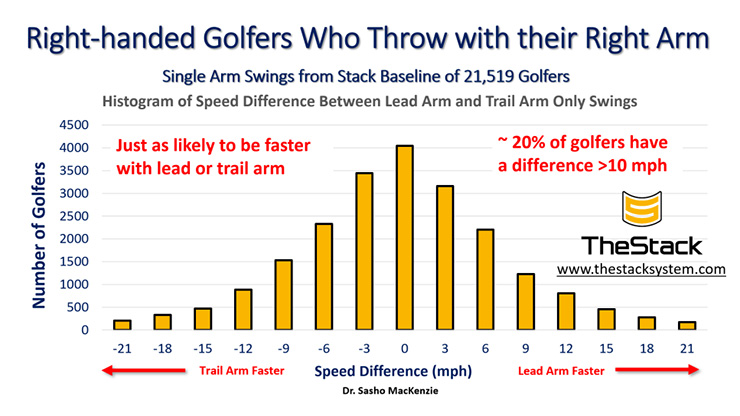
Part of the screening process for Sasho’s Stack Training aid measures golfers’ one-armed swings. It’s as simple as it sounds: Take a few swings with both your hands on a speed radar, then remove one arm, do the same, then again with the other arms.
When almost 30,000 golfers did this test, what did Sasho find?
That when it comes to right-handed golfers, there was a pretty even split, meaning that one arm wasn’t more likely to be faster than the other.
About 80 percent of lefties, by contrast, were likely to have their lead arm (which is their right arm) be faster than their left. But no, that’s probably something to worry about.
As Sasho explains:
“That’s an interesting take home. In very simplistic terms, it doesn’t even matter what your dominant hand is…For the vast majority of golfers, your non-dominant hand on the lead might actually be able to swing the club meaningfully faster than your dominant trail hand or vice versa. There’s no correlation.”
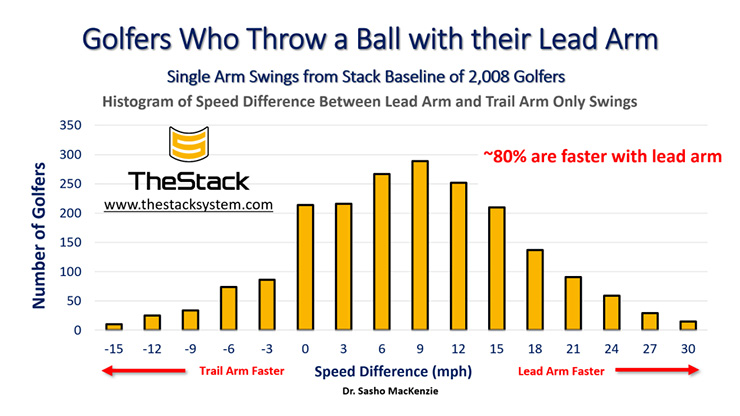
In short, Sasho says, one of your arms moving faster than the other isn’t a huge cause for concern. As long as it can keep up with the other arm when both arms are on the club, then you’ve not got anything to worry about.
It’s not hugely common, but if one of your arms is so weak and slow that it can’t keep up with your full-speed driver, that’s when you need to start training more one-armed swings.
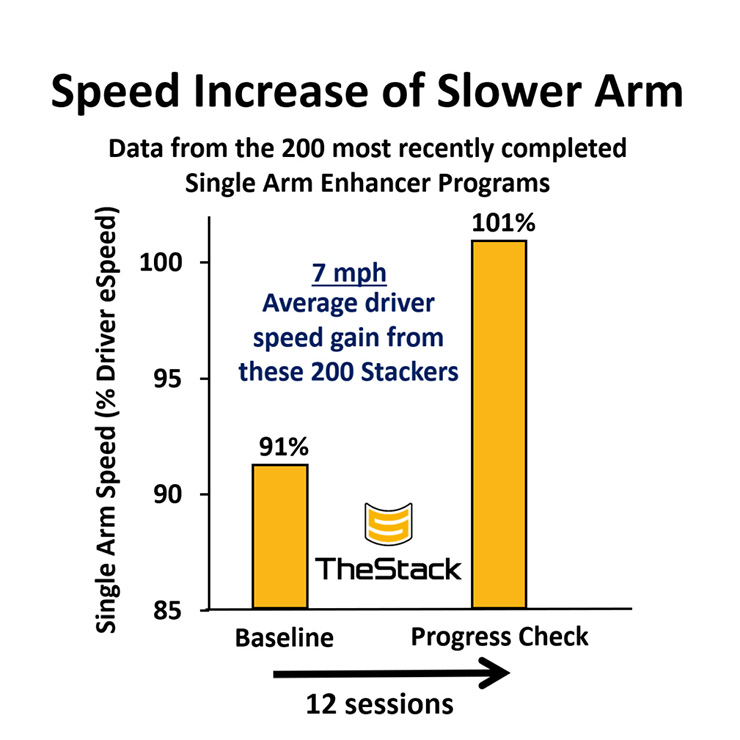
“It’s not the difference that matters. It’s how fast each of your arms can move relative to your driver speed,” Sasho explains. “In other words, if you have a 50 mph difference between your arms, a lot of golfers will focus on that difference, but closing that gap may not make a meaningful difference in your speed.”
Basically, one of your arms needs to be moving so slow that it’s not just struggling to keep up, it’s slowing down your other, faster arm. Again, it’s not hugely common, but if you are one of those golfers, Sasho’s Stack training aid clocked a 7 mph average speed gain by training to speed up that slower arm.
3 quick takeaways
1. You can test each of your arms’ speed by swinging one-handed, with a radar.
2. It’s ok if your arms move at different speeds.
3. If one of your single arms swings is close to your two-arm swing, and the other is way off, that’s probably a red flag.
Main image: Ben Walton