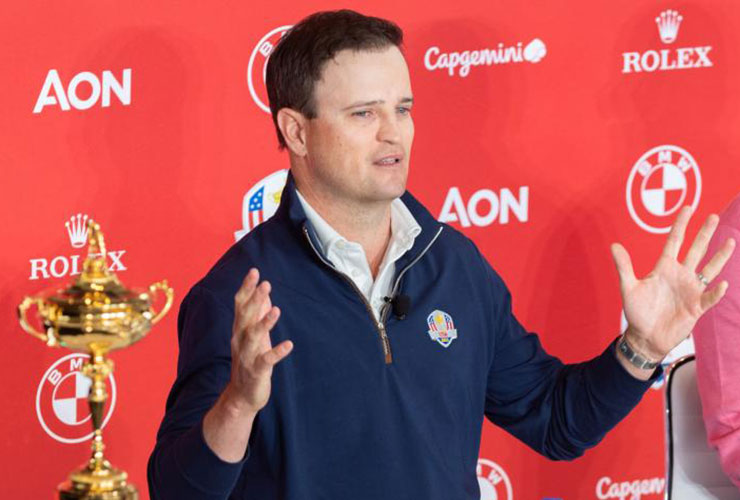
Zach Johnson’s goal for the coming season is to play well enough to qualify for the US Ryder Cup team on which he serves as captain. It’s ambitious for a player who hasn’t won in more than seven years, is 22 months removed from his last top-10 finish and turns 47 next month.
But, hey, it’s something for which to strive for a guy who has been an underdog his entire career. Whether the two-time major winner actually would play in the 44th Ryder Cup in September at Marco Simone Golf & Country Club near Rome is a discussion best saved for later.
RELATED: Tiger to play 2023 Ryder Cup?
Fitzpatrick hopes LIV Golfers are considered for Ryder Cup
Team Europe hope Ryder Cup won’t have LIV Golf cloud
Especially when there are so many other things to talk about in reference to leading a talented US team coming off a record victory over Europe two years ago at Whistling Straits and seeking to win for the first time on foreign soil since 1993.
“There is a lot of beautiful aspects to [the Ryder Cup], and I … would say almost selfishly, I love the fact that it’s difficult to win over there. Extremely difficult to win over there,” Johnson said on Wednesday at Waialae Country Club, where he captured one of his 12 PGA Tour titles (2009 Sony Open) and will compete for the 18th time. “I wouldn’t have it any other way. Yes, if it was my turn to represent our team [in the US], I would certainly take that upon myself if everybody saw fit. But if I had my choice, I would want to lead a team over there.
“I love difficult situations. I love being uncomfortable. I love proving everything wrong. It’s just the way I’m built, the way I’m wired. I keep saying it, but I love the word ‘opportunity.’ I don’t want to say there is more motivation, but when I turn on the TV and none of my teams are playing, I’m still going to watch sports, and I want the team that’s not supposed to win to win. That’s what drives me. That’s what gets me going. I like the Cinderellas.”
Probably because he can relate to those kinds of teams, no?
“I don’t know how parallel they are,” the Iowa native said, “but it’s a substantial difference between a team and what I do, or what I’ve done in my career. I’m not supposed to be necessarily sitting here, so …”
American golfers are coming off a convincing win last autumn in the Presidents Cup, beating the International team handily, 17.5-12.5 at Quail Hollow Club in Charlotte, North Carolina, for their ninth straight win and 12th overall in the biennial competition. The year prior, the US registered the largest margin of victory in the Ryder Cup, 19-9, since European players were added to competition in 1979.
Road woes aside, the US certainly will not be the underdogs in Italy. Which in some ways is a challenge all its own. Johnson understands that his job is to maintain the programme that his immediate predecessors — in this case, Davis Love III in the Presidents Cup and Steve Stricker in the Ryder Cup — have installed to enable those American teams to thrive. Not surprisingly, both men will assist Johnson in September.
“I think it was a caddie back in the day who told me … it was actually at a Presidents Cup [that] the captain can kind of put your players in a good position to go out and play good golf, but it’s easier to put your players in a position to go out and play bad golf,” Johnson said. “So my job is to eliminate most of that. It’s hard to do, but I want to put them in a place where they feel they’ve got ownership, expectations are met, and they can play free golf.”
Easier said than done, he said, when it was suggested, given the US talent pool and the way they have bought into both the Ryder Cup and Presidents Cup, that the job of the captain has been somewhat idiot proofed.
“I’m not going to say that,” he replied. “I’m fully vulnerable to screwing things up. We all are. I would say the continuity we have from Cup to Cup to Cup to Cup right now is something I’m very impressed with and grateful for. The ownership of the team, successful teams, tends to be taken on by the players, and that’s what we’re seeing. And I really, really like that.
“I appreciate and I fully acknowledge that there is something to be said about the system, the template that’s been laid in front of me,” he continued. “Yeah, it’s systematic, but it’s also not rigid. It has some fluidity and the ability to take on the personality of the leader and the leaders. It’s not perfect because we’re all imperfect, but the camaraderie, the chemistry, and the ownership of these players is very tangible.”